Lowell Observatory's annual "I Heart Pluto" Festival, celebrating the 92nd anniversary of Pluto's discovery on February 18, 1930, at the observatory in Flagstaff, Arizona, will this year be a combination of in-person and virtual events that will run from today, February 12 through Monday, February 21. You can find the entire schedule of events listed on the event's website. Speakers include Dr. Alan Stern; Dr. Cathy Olkin; Dr. Richard Binzel, former astronaut Dr. Nancy Currie-Gregg, Alden Tombaugh, son of Pluto discoverer Clyde Tombaugh, and many more. Don't miss this annual celebration of our favorite planet!
Saturday, February 12, 2022
Lowell Observatory Hosts Annual "I Heart Pluto" Festival, February 12-21
Lowell Observatory's annual "I Heart Pluto" Festival, celebrating the 92nd anniversary of Pluto's discovery on February 18, 1930, at the observatory in Flagstaff, Arizona, will this year be a combination of in-person and virtual events that will run from today, February 12 through Monday, February 21. You can find the entire schedule of events listed on the event's website. Speakers include Dr. Alan Stern; Dr. Cathy Olkin; Dr. Richard Binzel, former astronaut Dr. Nancy Currie-Gregg, Alden Tombaugh, son of Pluto discoverer Clyde Tombaugh, and many more. Don't miss this annual celebration of our favorite planet!
Tuesday, February 1, 2022
Monday, January 31, 2022
Tuesday, January 25, 2022
Icarus Paper Marks Turning Point for Pluto and for Geophysical Planet Definition
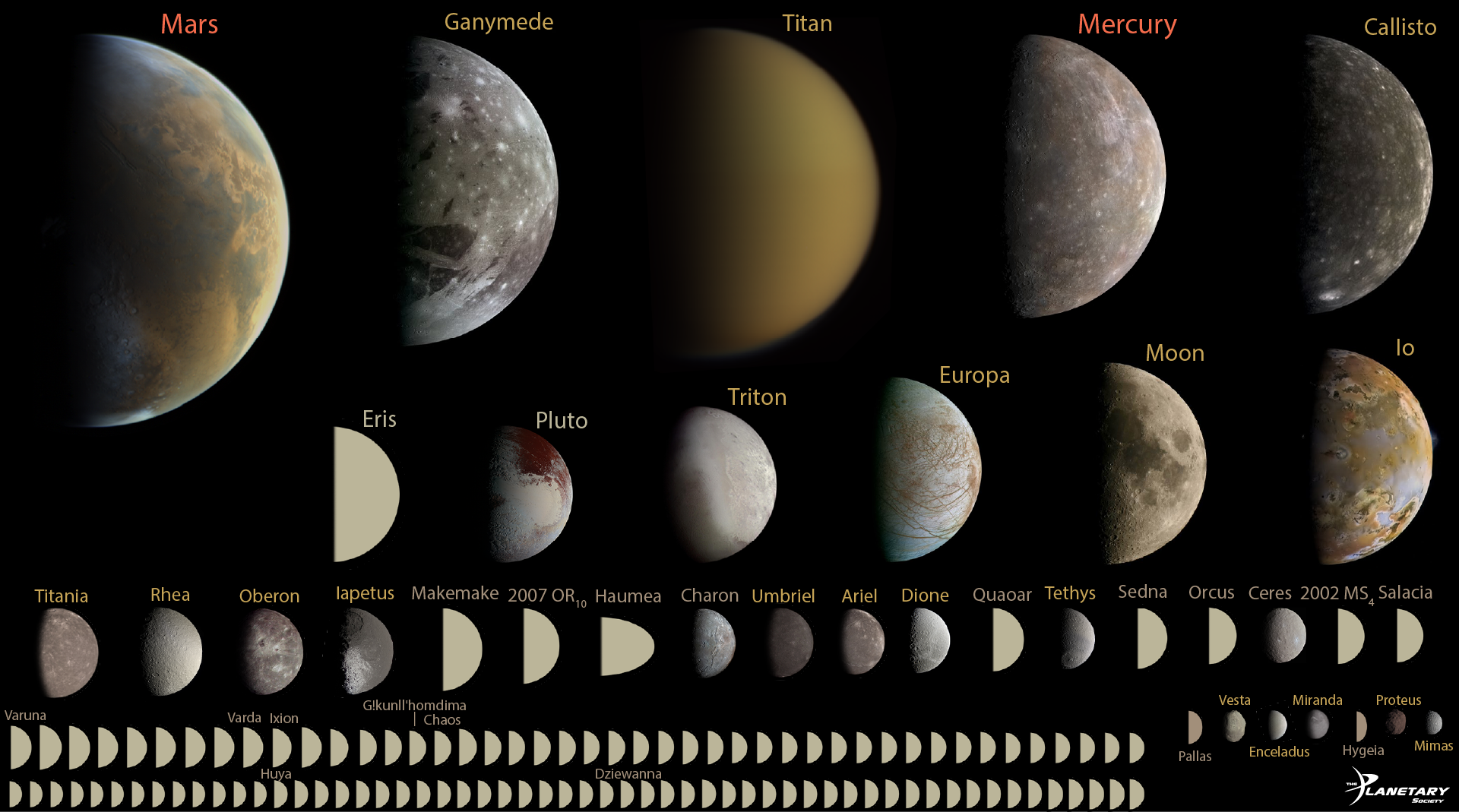
Depiction of all spherical worlds in the solar system with diameters under 10,000 kilometers. Credit: NASA / JPL, JHUAPL/SwRI, SSI, The Planetary Society, and UCLA / MPS / DLR / IDA, processed by Gordan Ugarkovic, Ted Stryk, Bjorn Jonsson, Roman Tkachenko, and Emily Lakdawalla
A peer-reviewed paper published in the March 2022 issue of the prestigious journal Icarus titled, “Moons Are planets: Scientific usefulness versus cultural teleology in the taxonomy of planetary science” has reignited the planet definition debate in a way that indicates we may be experiencing a turning point when it comes to planet definition.
The paper’s authors are Philip Metzger, Will Grundy, Mark Sykes, Alan Stern, Jim Bell, Charlene Detelich, Kirby Runyon, and Michael Summers. These scientists conducted an extensive study of planet definition over 400 years (since the time of Galileo) and found that the geophysical planet definition is the one that has been used most since then and the one most consistent with the Copernican Revolution, in which the Sun, rather than the Earth, was recognized as the center of the solar system.This paper is not centered on Pluto at all but focuses on spherical moons of planets, noting they were considered planets from the time of Galileo until the 19th century, when astrologers, folklorists, and almanac writers needed to keep the number of planets small and orderly to do horoscopes and make weather predictions.
When Galileo first turned his telescope on the Moon, he saw mountains that resembled those on Earth, from which he realized the Moon is also a planet with features similar to those on the Earth. Then, when he discovered the four largest moons of Jupiter, he described them as “four planets circling the star of Jupiter.” This latter point is noted in David Weintraub’s 2007 book, Is Pluto a Planet?
For most of the last 400 years, planets were defined not by their orbital positions, which can and do change, but by their geophysical and geological processes. Spherical moons were classed as secondary or satellite planets, as they clearly have the same processes that primary planets do.
When the IAU adopted its 2006 definition, a strong motivation was keeping the number of solar system planets small, supposedly so children can memorize them. This need for a small number of planets in a neatly, ordered solar system, in which all orbit on the same plane, was an erroneous concept based on culture rather than science.
“This might seem like a small change, but it undermined the central idea about planets that had been passed down from Galileo. Planets were no longer defined by virtue of being complex, with active geology and the potential for life and civilization. Instead, they were defined by virtue of being simple, following certain idealized paths around the Sun,” noted study lead author Philip Metzger of the University of Central Florida (UCF).
As noted previously on many occasions, memorization of a list of planet names is an archaic method of teaching the solar system that dates back to before the space age, when little else was known about the planets other than their names. Today, memorization makes little sense and teaches nothing about the actual planets.
A better method of education involves teaching planet as a broad umbrella category and then focusing on the major characteristics of each planet subclass. Just like students have access to the entire Periodic Table available to them, they can be given complete lists of the solar system’s many planets for reference without having to memorize anything.
Numerous articles have been written in response to this paper, including mine in SpaceFlight Insider, which goes into more detail describing the Icarus paper. Others have been published by the University of Central Florida, WMFE, NBC News, The New York Times, Anton Petrov’s YouTube channel, Dr. Becky’s YouTube channel, Deseret News, The A.V. Club, and many more.
Dr. Becky even admitted in her video that this paper is making her take a second look at the planet definition issue. Several commenters on various websites said the same thing.
In addition to changes of mind by people who formerly supported the IAU definition, there are now new books either out or scheduled to be published that take a pro-geophysical definition stand.
Welcome Back Pluto: We’re Glad that You’re a Planet Again by Ron Toms, published in October 2021, explores the weaknesses of the IAU planet definition and actually ends with a chapter titled, “How You Can Make Pluto a Planet Again.”
Of course, Pluto never stopped being a planet. A vote by 333 people does not have the power to change what Pluto is. This section should be worded, “How You Can Make Pluto Recognized as a Planet Again.” Nevertheless, this is very encouraging, and I urge all interested in this subject to purchase this book. I intend to do so myself and to review it on this blog.
In his book, Toms states what many of us have been repeating for more than 15 years: “Don’t fall victim to the logical fallacy known as appeal to authority. The IAU’s definition of planet does not pass scrutiny in spite of their self-proclaimed authority. Anyone can do this. The emperor has no clothes.”
Toms goes on to take issue with the claim that the IAU definition is somehow the “official” one, pointing out that anyone can create a definition and call it “official.”
Within a Facebook discussion of the planet definition controversy, one writer announced plans to write a children’s book about the Kuiper Belt from the standpoint of the geophysical planet definition. I will present more information about this project as it becomes available.
This is an amazing turn of events, and we have the authors of the Icarus article, who spent five years going over four centuries of planetary science literature, to thank for it.
New York Times science writer Ken Chang embedded a poll in his article asking people questions not just about Pluto but also whether Eris and Earth’s Moon should be considered planets. Unfortunately, too few people are familiar with Eris, and too many Pluto supporters advocate only the nine-planet solar system. But even this does not work in favor of the IAU or its problematic definition. A major reason few people learned about Eris and about the geophysical definition is that the IAU vote was centered completely on Pluto. The media story was their removal of Pluto, not the discovery of additional planets in our solar system. So kids are actually learning less about the solar system now than they did prior to the IAU vote, unless their teachers choose to teach a more inclusive view of the solar system.
The poll is therefore not an indictment of Pluto supporters but of the mainstream media, textbook publishers, and educational systems that blindly adopted the IAU position back in 2006 rather than question it, learn the entire story behind it, and teach the controversy.
Back in the 1600s, church leaders refused to look through Galileo’s telescope, which would have enabled them to learn that his discoveries were real and correct. Today, it seems we’re stuck with another so-called “authority” that refuses to look at the latest data on everything from missions to dwarf planets to history to the discovery of exoplanets, all so they can stick to their dogma. If history has anything to say about this, the latter view will not prevail.
Friday, January 21, 2022
Tuesday, January 18, 2022
Please vote for geophysical planet definition in New York Times Poll
I will be writing more later about the planet definition debate heating up again, thanks to a paper published in the journal Icarus explaining why the IAU planet definition is based on astrology and folklore. For now, New York Times Science writer Ken Chang is holding an active poll in an article he wrote today, not just about Pluto's planet status but on the geophysical planet definition. Too many people have responded in favor of just a nine-planet solar system as opposed to one based on the geophysical defintiion, in which Eris, all dwarf planets, and spherical moons are counted as planets. Please visit the article and answer all the questions in support of the geophysical definition. This is not just about Pluto!
Here is the link: https://www.nytimes.com/interactive/2022/science/is-pluto-a-planet.html?smid=tw-share
Tuesday, December 21, 2021
Winter Solstice: Turn the Darkness into Light
The solar cycle can be viewed as analogous to the lunar cycle. One lunation begins at the first sight of the waxing crescent Moon moving away from its dark phase, in which the Moon is conjunct the Sun. The waxing half of the cycle lasts until the full Moon, after which, the Moon begins to wane. The lunation ends when it wanes into complete darkness.
With the Sun, from Earth’s point of view, at least from the Northern Hemisphere, a new solar orbit begins at the moment we move away from the darkest point, the Sun at its nadir, much like the dark Moon. The first half of the year can be seen as the waxing year, as the Sun appears to grow stronger. Summer Solstice corresponds to the full Moon, the peak of light, after which the Sun appears to wane until it returns to its weakest point.
According to this view, the New Year began today following the Solstice at 10:59 AM EST.
Like the one before it (2020), the past year has been a difficult one. The Earth continues on a dangerous trajectory toward climate crisis, and the signs have been stronger than ever in the form of wildfires, extreme storms, extreme heat waves, melting ice at both poles. Some areas experienced severe drought while others endured major floods—extremes predicted decades ago as the effects of global warming on Earth’s hydrologic cycle.
And yet, in the face of all this as well as a global pandemic coming up on two years, those with the most power have been unable and/or unwilling to commit to the bold changes we need to save the habitability of this planet. If 100-degree Fahrenheit temperatures in Siberia won’t motivate us to change, what will?
The answer is that change begins with each one of us. During the darkest time of the year, we make our own warmth and our own light. No other season so drives home the truth that we all need each other to survive.
Maybe what we really need to do is look at this time period through the lens of the Winter Solstice. Dispelling the dark has to begin within each one of us. We can’t wait for action by those in power. We are the people who can save the habitability of this planet, both for ourselves and for its numerous plant and animal species. We need to stop waiting for those in power to act, find our own power within, and come together to bring light to the darkness, to fight for a better world. This song, sung both at protests and at the Winter Solstice says it best:
“We are the rising Sun!
We are the change!
We are the ones we’ve been waiting for,
And we are dawning!”
And as the song, “Yule, Bless this Night” states:
“Hey, hey, bless this night
Turn the darkness into light!
“Hey, hey bless our way,
Lead us to a brighter day!”